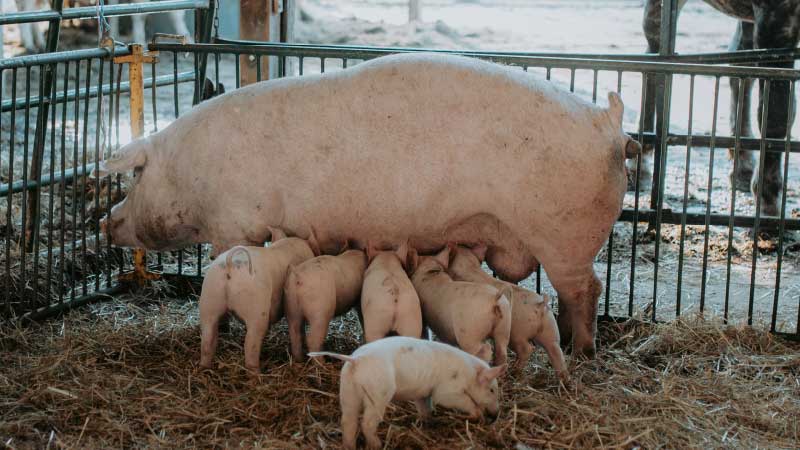
You did everything right. Your sow farrowed 14 healthy piglets yesterday. But when the piglets try to nurse, nothing comes out. You gave 2ml of oxytocin in the morning, 2ml in the afternoon. Nothing. Today you increased to 3ml morning, 3ml afternoon. Still nothing. The piglets are getting lean. You are getting desperate.
This exact scenario plays out in pig farming WhatsApp groups every week. The farmer keeps increasing the oxytocin dose, hoping more will work. But here is the hard truth: oxytocin only treats ONE of the six causes of agalactia (failure to produce milk). If the cause is mastitis, metritis, retained placenta, stress, dehydration, or hypocalcemia, all the oxytocin in the world will not help — because oxytocin only triggers milk let-down, it does not create milk or cure infections [1][2].
Understanding the MMA complex
Veterinarians call this condition MMA — Mastitis-Metritis-Agalactia complex, also known as Postpartum Dysgalactia Syndrome (PDS). It typically appears 12 hours to 3 days after farrowing [3]. The three components are:
- Mastitis: bacterial infection of the mammary gland (udder). The gland becomes hot, swollen, and painful.
- Metritis: bacterial infection of the uterus, often from a retained placenta or unsanitary farrowing conditions.
- Agalactia: the failure to produce or release milk. This is the symptom you see — but it is usually caused by mastitis or metritis, not a primary milk production problem.
Oxytocin is a hormone that triggers milk let-down — the release of milk from the alveoli into the ducts so piglets can suckle it. It does NOT create milk, does NOT cure infections, and does NOT reduce inflammation. If the udder is infected (mastitis) or the uterus is infected (metritis), the milk is either not being produced or is being blocked from release by inflammation. Oxytocin cannot fix either of those problems [2][3].
The 6 causes of agalactia — and what to do for each
1. Mastitis (bacterial udder infection)
How to identify: Feel the udder. A healthy lactating udder is soft, warm, and yields milk when gently squeezed. A mastitic udder is hot, hard, swollen, and painful — the sow will flinch or grunt when you touch it. The milk may look abnormal (thick, yellow, bloody, or clotted).
What to do: Oxytocin will NOT help. You need antibiotics + anti-inflammatories. The standard treatment is: (a) Dexamethasone 20ml IM (reduces inflammation dramatically) [4]; (b) Penicillin-Streptomycin (Penstrep) 10ml IM twice daily for 3-5 days; (c) NSAIDs like meloxicam or flunixin for pain + inflammation; (d) warm compresses + udder massage with warm water 3-4 times daily. Continue piglet supplementation with milk replacer during treatment.
2. Metritis (uterine infection)
How to identify: Check the vulva. A foul-smelling, yellow-brown, or purulent discharge indicates uterine infection. The sow may also have a fever (>39.5°C rectal). If the placenta was retained (not passed within 4-6 hours of the last piglet), metritis is almost guaranteed.
What to do: Oxytocin may help expel retained placenta or uterine debris (10-20 IU IM, repeat every 2-4 hours — oxytocin's half-life is only 6-7 minutes so frequent dosing is safe) [5]. But you also need antibiotics: Penstrep or oxytetracycline IM for 5 days. If the placenta is retained and you cannot remove it manually, call a veterinarian — prostaglandin injection (PGF2α) may be needed to expel it.
3. Retained placenta (mechanical blockage)
How to identify: If the placenta has not passed within 4-6 hours of the last piglet, it is retained. You may see a portion hanging from the vulva, or nothing at all. The sow will be restless, off feed, and may have a fever.
What to do: Oxytocin 10-20 IU IM every 2-4 hours for up to 3 doses may help the uterus contract and expel it [5]. If still retained after 12 hours, you need veterinary intervention — manual removal under sedation, or prostaglandin injection. Do NOT pull forcefully — you can tear the uterus and kill the sow.
4. Stress (adrenaline blocks oxytocin)
How to identify: The sow is restless, pacing, or aggressive toward piglets. Maybe she was moved to a new pen too close to farrowing. Maybe there are loud noises, dogs, or strangers nearby. Maybe the farrowing pen is too hot (>30°C) or too cold (<15°C).
What to do: Adrenaline (the stress hormone) directly blocks oxytocin release. This is why oxytocin injections sometimes fail in stressed sows — the adrenaline is overriding the oxytocin you injected. Remove all stressors: quiet environment, no dogs, no strangers, dim lighting, comfortable temperature (18-22°C). Stay with the sow quietly. Once she relaxes, her natural oxytocin (plus any injected oxytocin) will work. Oxytocin injection 10-20 IU IM may still help, but only AFTER stress is removed [2].
5. Dehydration (no water = no milk)
How to identify: A lactating sow needs 25-30 liters of water per day to produce milk. If her waterer is empty, blocked, or the water is warm (>30°C), she is not drinking enough. Pinch the skin on her neck — if it does not spring back immediately, she is dehydrated.
What to do: Provide clean, fresh, cool water immediately. Add electrolytes to the water for the first 48 hours. Check the waterer 3-4 times per day. Oxytocin will NOT work if the sow is dehydrated — milk is 80% water, and you cannot make milk without water.
6. Hypocalcemia (calcium deficiency / "milk fever")
How to identify: The sow is weak, reluctant to stand, muscle tremors, and may have a subnormal temperature (<38°C). This is most common in high-producing sows with large litters (10+ piglets). The demand for calcium (for milk production) exceeds the supply, causing a drop in blood calcium.
What to do: Oxytocin will NOT help. You need calcium: intravenous calcium gluconate (100-200ml of 5% solution, slowly, over 10-15 minutes) — this is the fastest treatment and the sow will often respond within minutes. If you cannot do IV, give calcium borogluconate subcutaneously (slower but safer). Oral calcium paste is a preventative, not a treatment. Call a vet for IV calcium — too fast IV administration can cause cardiac arrest.
The 24-hour action plan when your sow has no milk
If your sow farrowed and is not producing milk, do NOT just keep injecting oxytocin. Follow this sequence:
- Step 1 (0-1 hour): Diagnose the cause. Feel the udder (hot/hard = mastitis). Check vulva discharge (foul = metritis). Check placenta (retained?). Check water availability. Check temperature (fever = infection; low = hypocalcemia). Remove stressors.
- Step 2 (1-2 hours): Piglet survival. Piglets cannot survive more than 6-12 hours without colostrum. If diagnosis takes longer, feed piglets warm (38°C) colostrum replacer or cow colostrum via stomach tube (20-30ml per piglet). If no colostrum replacer, give 5% glucose solution (1 tablespoon sugar in 100ml warm water) — this is NOT colostrum but prevents hypoglycemia death for 6-8 hours.
- Step 3 (2-6 hours): Treat the underlying cause. Mastitis → antibiotics + dexamethasone. Metritis → antibiotics + oxytocin for uterine clearance. Retained placenta → oxytocin + vet call. Stress → remove stressors. Dehydration → electrolytes. Hypocalcemia → IV calcium (vet call).
- Step 4 (6-24 hours): Supportive care. Keep piglets warm (heat lamp, 33-35°C for first 3 days). Continue piglet supplementation every 4-6 hours until the sow is producing milk. Monitor the sow's appetite, water intake, temperature, and udder condition.
- Step 5 (24 hours): Decision point. If the sow is still not producing milk after 24 hours of correct treatment, the prognosis is poor. Continue piglet rearing artificially (milk replacer every 4 hours, gradually introducing creep feed at day 7-10). Consider fostering piglets to another lactating sow if available. The sow may need culling if she has chronic mastitis or repeat agalactia across litters.
Prevention: how to avoid this next time
MMA complex is largely preventable with good management:
- Move the sow to the farrowing pen 5-7 days before expected farrowing (allows acclimation, reduces stress)
- Wash and disinfect the farrowing pen with iodine before the sow enters
- Reduce feed from 3kg to 2kg/day in the last 3 days before farrowing (prevents constipation, which contributes to MMA)
- Add 10g Epsom salt (magnesium sulfate) to feed daily in the last week (laxative, prevents constipation)
- Ensure unlimited clean water — a farrowing sow drinks 25-30 liters
- Keep the farrowing environment quiet, dim, and 18-22°C
- Have a farrowing kit ready: clean towels, iodine, oxytocin, penicillin, dexamethasone, iron injection, piglet milk replacer
- Consider preventive antibiotics (Penstrep IM on day of farrowing) for sows with a history of MMA
FarmWise tracks your sow's service date, automatically calculates the expected farrowing date (service + 114 days), and surfaces this preparation checklist 7 days before farrowing. When farrowing begins, the SOS wizard asks 5 diagnostic questions and outputs the most likely cause + treatment — so you spend time treating, not guessing.
Sources & References
- [1] MSD Veterinary Manual: Postpartum Dysgalactia Syndrome in Sows — treatment includes NSAIDs + oxytocin; antimicrobials indicated if underlying infection. Source: msdvetmanual.com
- [2] AHDB (Agriculture and Horticulture Development Board, UK): Mastitis, metritis and agalactia (MMA) in sows — small doses of oxytocin can help but should not be necessary if piglets are suckling regularly. Source: ahdb.org.uk
- [3] The Standard (Kenya): How to diagnose and treat MMA in pig farming — MMA is seen in sows 12 hours to 3 days after farrowing. Source: standardmedia.co.ke
- [4] Engormix: Causes of mastitis on sow — dexamethasone 20cc IM is the first treatment for mastitis. Source: engormix.com
- [5] University of Minnesota Conservancy: Mastitis-Metritis-Agalactia (MMA) — biological half-life of oxytocin is 6-7 minutes; injections can be given every 2-4 hours without harm. Source: conservancy.umn.edu
FarmWise tracks all of this automatically for your farm.
Start free