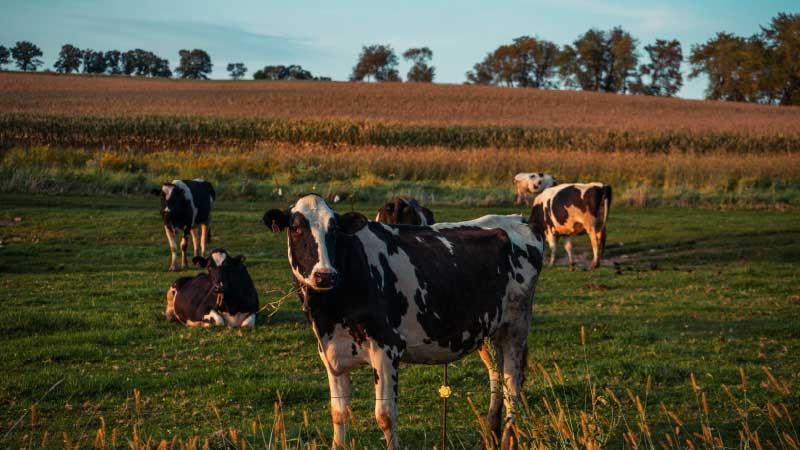
The most profitable farms in the world are not specialized - they are integrated. A specialized pig farm buys feed, raises pigs, sells pigs, and throws away the manure. An integrated farm grows maize to feed pigs, pig manure composts to fertilize vegetables, vegetable waste feeds poultry, poultry manure fertilizes the maize. Each "waste" of one enterprise becomes the input of another. Integration reduces input costs by 25-40 percent, creates multiple income streams that buffer against price volatility, and builds soil fertility that compounds year after year. This article is the design guide for crop-livestock integration on small and medium African farms.
The 5 integration loops (and the math of each)
Five integration loops that work in African conditions, with the value each generates per year for a 2-hectare farm with 20 sows and 1,000 layers:
Loop 1: Maize → Pigs → Manure → Maize
Grow 1 hectare of maize yielding 4 tons. Use it as the energy base for your pig feed (saves buying commercial maize at 200+ FCFA/kg). The 20 sows + growing piglets produce 60 tons of fresh manure per year, which composted (at 2:1 with sawdust) yields 30 tons of compost worth 7,000 FCFA (~$11.7)/ton applied to the maize field - replacing commercial NPK fertilizer (saving 200,000 FCFA (~$333)/year).
Net value: 4 tons maize saved = 800,000 FCFA (~$1333)/year in feed cost, plus 200,000 FCFA (~$333) in fertilizer saved = 1,000,000 FCFA (~$1667)/year.
Loop 2: Layers → Eggs + Cull hens → Pigs
Spent laying hens (culled at 18 months old) are often sold at low prices (1,500 FCFA (~$0.83) each) or thrown away. Instead, cook them with maize bran to create a high-protein pig feed supplement. 1,000 culled layers per year = 1,500 kg of pig feed at 12% protein, replacing purchased fish meal worth 1,200,000 FCFA (~$2000)/year.
Bonus: this eliminates the disposal problem of cull hens and provides pigs with a balanced amino acid profile superior to commercial feed.
Loop 3: Pigs → Manure → Vegetables → Market
Use composted pig manure to fertilize a 0.5-hectare vegetable plot (tomatoes, peppers, cabbage, leafy greens). Without chemical fertilizer, yield is typically 15-25 tons of vegetables per year, sold at 500-1,500 FCFA (~$2.50)/kg. Revenue: 10-30 million FCFA per year from vegetables alone.
The labor for vegetable cultivation can be done by the same farm workers, with seasonal hiring at harvest. The profit margin on vegetables fertilized by free compost is 70-85 percent (versus 30-50 percent for vegetables fertilized with purchased NPK).
Loop 4: Vegetable waste + Crop residues → Poultry
Vegetable cultivation generates 30-40 percent waste (culls, outer leaves, stems). Feed these to poultry - layers love vegetable greens and accept them as 15-20 percent of their daily intake. For 1,000 layers, this saves 70-100 kg of purchased feed per month, or 200,000-300,000 FCFA (~$500)/year.
Crop residues (maize stover, groundnut hay, cassava peels) can also be fed to pigs after appropriate processing (chopping, drying, soaking, or ensiling).
Loop 5: Poultry manure → Fish pond → Vegetables
If you have space for a 200-500 m2 fish pond, poultry manure (from 1,000 layers, ~3 tons per year) can fertilize the pond to produce plankton that feeds tilapia. Yields: 200-500 kg of fish per year, sold at 1,500-2,500 FCFA (~$4.17)/kg = 300,000-1,250,000 FCFA (~$2083)/year.
Pond water, rich in dissolved nutrients, is then used to irrigate vegetables - closing another loop.
The total integration value
Summing all 5 loops: 1,000,000 + 1,200,000 + 10-30M + 250,000 + 300-1,250,000 FCFA (~$2083)/year in additional value or savings. Realistically, even a partial integration (3 of 5 loops implemented) generates 3-5 million FCFA per year in additional profit on a 2-hectare farm.
The most important point: this is NEW profit, not reallocated profit. The land, labor, and capital are largely the same as a specialized operation. Only the design has changed - and design is free.
Farm layout: how to physically arrange integration
Integration requires physical proximity so that moving waste from one enterprise to another is cheap and easy. The ideal layout for a 2-hectare integrated farm:
- Center: the pig house and poultry house, close together (within 50m) so workers can service both daily.
- North of the animal houses: the manure composting area, downwind of the houses but close enough to wheelbarrow manure daily.
- Downhill from the compost area: the vegetable plot, where compost is easily moved.
- On the perimeter: the maize field (1 ha), which gets compost once a year at planting.
- Lowest point of the farm: the fish pond (if included), which receives poultry manure and provides nutrient-rich water for vegetable irrigation.
- Near the entrance: the farm office, feed storage, and processing area - accessible to delivery trucks without crossing through the animal areas.
Water and drainage flow downhill, so arrange the enterprises so that water from one naturally irrigates or fertilizes the next. Do not fight gravity - work with it.
The 7 principles of integration design
- Waste is food. Every output of one enterprise should be designed as the input of another. If you are throwing anything away (manure, culls, crop residues, waste water), you are leaving money on the table.
- Close the loops locally. The shorter the distance between where waste is produced and where it is consumed, the cheaper the system. Manure used on the same farm where it is produced costs nothing to transport.
- Match enterprise scale. A 100-sow operation produces too much manure for a 0.5-hectare vegetable plot. Match the size of each enterprise to what the others can absorb. Imbalance creates waste (and waste = lost profit).
- Sequence enterprises by nutrient density. Highest-nutrient waste (pig manure, poultry manure) goes to the most nutrient-demanding crop (vegetables). Lower-nutrient waste (compost residues, pond water) goes to less demanding crops (maize, fodder).
- Diversify for risk management. Integration is not just about efficiency - it is about resilience. If pig prices crash, vegetable and egg income sustain the farm. If drought kills the maize crop, purchased feed can be offset by higher poultry and vegetable revenue.
- Plan labor holistically. Different enterprises have different peak labor periods. Maize planting (March), pig farrowing (year-round), vegetable harvest (July-October), poultry batch transitions (every 6 weeks). A well-designed integration spreads labor demand across the year, avoiding both overload and idle time.
- Document everything. Each enterprise's revenue, costs, and inter-enterprise transfers (manure moved, vegetables fed to pigs) must be tracked. Without records, you cannot tell which loops are profitable and which are not - and you cannot optimize what you do not measure.
Starting integration: the 12-month roadmap
If you are currently running a single-enterprise farm (pigs only, or poultry only, or crops only), here is how to integrate over 12 months:
Months 1-3: Audit current waste. What are you throwing away? Manure, culls, crop residues, waste water? Quantify each. Decide which 1-2 integration loops are easiest to start with based on your current enterprises.
Months 4-6: Build the infrastructure for the first loop. If starting with manure-to-compost, build the composting area and source sawdust. If starting with cull-to-pig-feed, build a simple cooking setup. Keep investment low (<500,000 FCFA (~$833)) for the first loop.
Months 7-9: Operate the first loop, track results. Did composting reduce your fertilizer bill? Did cull-to-feed reduce purchased feed? Quantify the savings. If positive, expand to a second loop. If negative, fix the operation before expanding.
Months 10-12: Add a second loop. Plan the third loop for the next year. Each loop added takes 3-6 months to fully operationalize and another 3-6 months to validate the financial return. Full integration of 4-5 loops takes 2-3 years - that is normal.
The 4 most common integration mistakes
- Adding too many enterprises too fast. Each new enterprise has a learning curve. Adding vegetables, fish, and pigs in the same year overwhelms the farmer and most of the additions fail. Add one enterprise per year, master it, then add the next.
- Ignoring nutrient balance. A 500-bird layer operation produces 1.5 tons of manure per month. If you apply that fresh to a 100m2 vegetable plot, you burn the soil with excess nitrogen. Compost first, then apply at the rate the soil can absorb.
- Mixing diseased animals with crops. Do not feed diseased poultry or pigs to other animals - this transmits pathogens. Only feed healthy culls, and always cook them first to kill any pathogens.
- Failing to track inter-enterprise transfers. When manure moves from pigs to vegetables, is that a cost to the pig enterprise and revenue to the vegetable enterprise? Or is it just "free"? Decide on a consistent accounting method (transfer at fair market value) so each enterprise's true profitability is visible.
The endgame: the self-sufficient farm
The ultimate goal of integration is a farm that buys almost nothing from outside and sells multiple products to multiple markets. Inputs: chicks/pullets (every 18 months), pig breeder replacements (every 3-5 years), vaccines, premix, salt, and equipment. Everything else - feed, fertilizer, fuel (biogas from manure), labor (mostly family) - is produced on the farm.
This is not a return to subsistence farming. It is the opposite: a highly commercial, diversified, low-cost operation that captures every dollar of value that flows through it. The integrated farmer is not the biggest farmer in the village - he is the one whose bank account grows the fastest, because he spends the least on inputs and earns from the most products.
FarmWise is built for integrated farms: each enterprise (pigs, poultry, crops, feed mill) is tracked as a separate cost center with its own P&L, but inter-enterprise transfers (manure to compost to vegetables, cull hens to pig feed) are recorded so you can see the true profitability of each loop. Integration without measurement is just complexity. Integration with measurement is the path to a self-sufficient, resilient, and highly profitable farm.
Sources & References
- [1] Cameroon maize wholesale price 160 FCFA/kg (agrov.cm 2026); compost market value 5,000-8,000 FCFA/ton. Source: https://www.agrov.cm
- [2] Crop-livestock integration principles per FAO Integrated Farming Systems Guidelines and ILRI field studies. Source: https://www.fao.org
- [3] Cameroon pig manure production rates (~5 tons/year per 20-sow operation) per FAO Animal Waste Management Handbook. Source: https://www.fao.org
FarmWise tracks all of this automatically for your farm.
Start free